

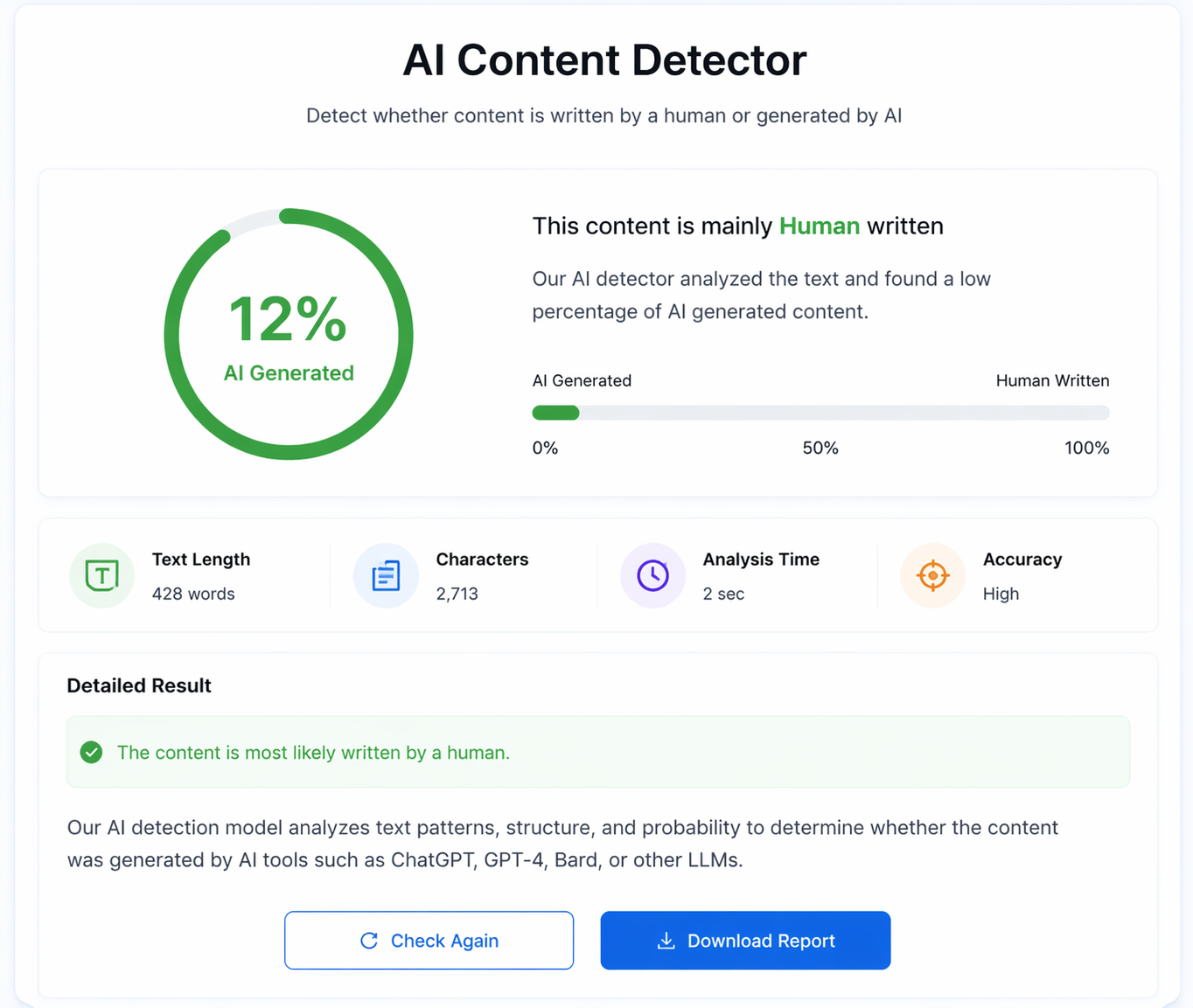
Description
Introduction: The Rise of Content Verification
As artificial intelligence continues to redefine how content is created, the need to verify originality has become more important than ever. Enter the ai detector—a tool designed not just to identify machine-generated text, but to protect authenticity in a rapidly evolving digital landscape. From academic institutions to marketing agencies, AI detectors are quickly becoming essential in maintaining trust and transparency.
What Is an AI Detector?
An AI detector is a specialized tool that analyzes text to determine whether it was written by a human or generated by artificial intelligence. Using advanced linguistic models, these tools evaluate patterns such as sentence structure, predictability, and contextual flow. Unlike plagiarism checkers, which compare content against existing sources, AI detectors focus on how the content is constructed.
This distinction makes them uniquely valuable in today’s content-driven world, where originality is no longer just about avoiding duplication—it’s about ensuring genuine human expression.
Why AI Detectors Matter More Than Ever
The proliferation of AI writing tools has increased the speed and accessibility of article creation. However, this convenience comes with challenges. Businesses risk publishing generic or repetitive material, while educators face difficulties in assessing student work.
AI detectors address these issues by:
Ensuring content integrity
Supporting academic honesty
Helping brands maintain a unique voice
Reducing the spread of low-quality automated content
In short, they act as a filter between authentic creativity and automated output.
How AI Detectors Work Behind the Scenes
AI detectors rely on machine learning algorithms trained on vast datasets of both human-written and AI-generated text. They analyze several key factors:
1. Perplexity
This gauges a text's degree of predictability. AI-generated content often follows highly predictable patterns, while human writing tends to vary more naturally.
2. Burstiness
Human writing usually includes a mix of short and long sentences, creating a dynamic rhythm. AI content often lacks this variation, appearing more uniform.
3. Contextual Depth
AI detectors assess whether the content demonstrates deep understanding or simply stitches together surface-level information.
By combining these signals, the tool produces a probability score indicating whether the content is AI-generated.
Benefits of Using an AI Detector
Enhancing Content Quality
Writers and editors can use KI detector to refine their work, ensuring it feels natural and engaging rather than robotic.
Building Audience Trust
Audiences are increasingly aware of AI-generated content. Verifying authenticity helps build credibility and long-term trust.
Improving SEO Performance
Search engines prioritize high-quality, original content. Using an AI detector can help ensure your material meets these standards, boosting visibility.
Supporting Ethical Content Practices
AI detectors encourage responsible use of technology, promoting transparency instead of deception.
Common Misconceptions About AI Detectors
Despite their growing popularity, AI detectors are often misunderstood.
They are not 100% accurate: No tool can guarantee perfect detection, as AI models continue to evolve.
They don’t replace human judgment: They should be used as a guide, not a final authority.
They are not plagiarism tools: Their purpose is to detect writing style, not copied content.
Understanding these limitations is key to using AI detectors effectively.
Best Practices for Using an AI Detector
To get the most out of an AI detector, consider the following strategies:
Use it as part of your editing process rather than a one-time check
Combine results with manual review for better accuracy
Focus on improving content quality instead of just “passing” detection
Avoid over-reliance; creativity should remain your primary tool
By integrating these practices, you can ensure your content remains both authentic and impactful.
The Future of AI Detection Technology
As AI writing tools become more sophisticated, AI detectors will also evolve. Future advancements may include real-time detection, deeper contextual analysis, and integration with content management systems.
More importantly, the role of AI detectors will expand beyond detection. They may soon guide writers in creating more human-like, emotionally resonant content—blurring the line between verification and enhancement.
Conclusion: Authenticity in the Age of Automation
The digital world is at a crossroads where automation meets authenticity. While AI tools offer incredible efficiency, they cannot replace the nuance of human creativity. An AI detector serves as a safeguard, ensuring that content remains genuine, trustworthy, and meaningful.
Rather than viewing these tools as restrictive, they should be seen as enablers—helping writers, businesses, and educators maintain high standards in an increasingly automated environment.
Check Out More Latest Articles: Click Here